

Access 32-bit database cannot be opened with 64-bit Office? Solution

Javier Garcia
How can I support you?

Javier Garcia
Senior Cloud Computing Engineer

+41.. Show number +41 55 253 00 53

Microsoft Access no longer works after the update?

After switching from 32-bit to 64-bit Office, your Access database no longer opens? Error messages appear, VBA code crashes, or individual functions no longer work?

This problem occurs much more frequently than many people expect when switching to 64-bit, especially with older, established Access solutions.

In this article, you will learn why this happens, what short-term solutions are available, and when it makes sense to fundamentally question the future viability of your Access database.
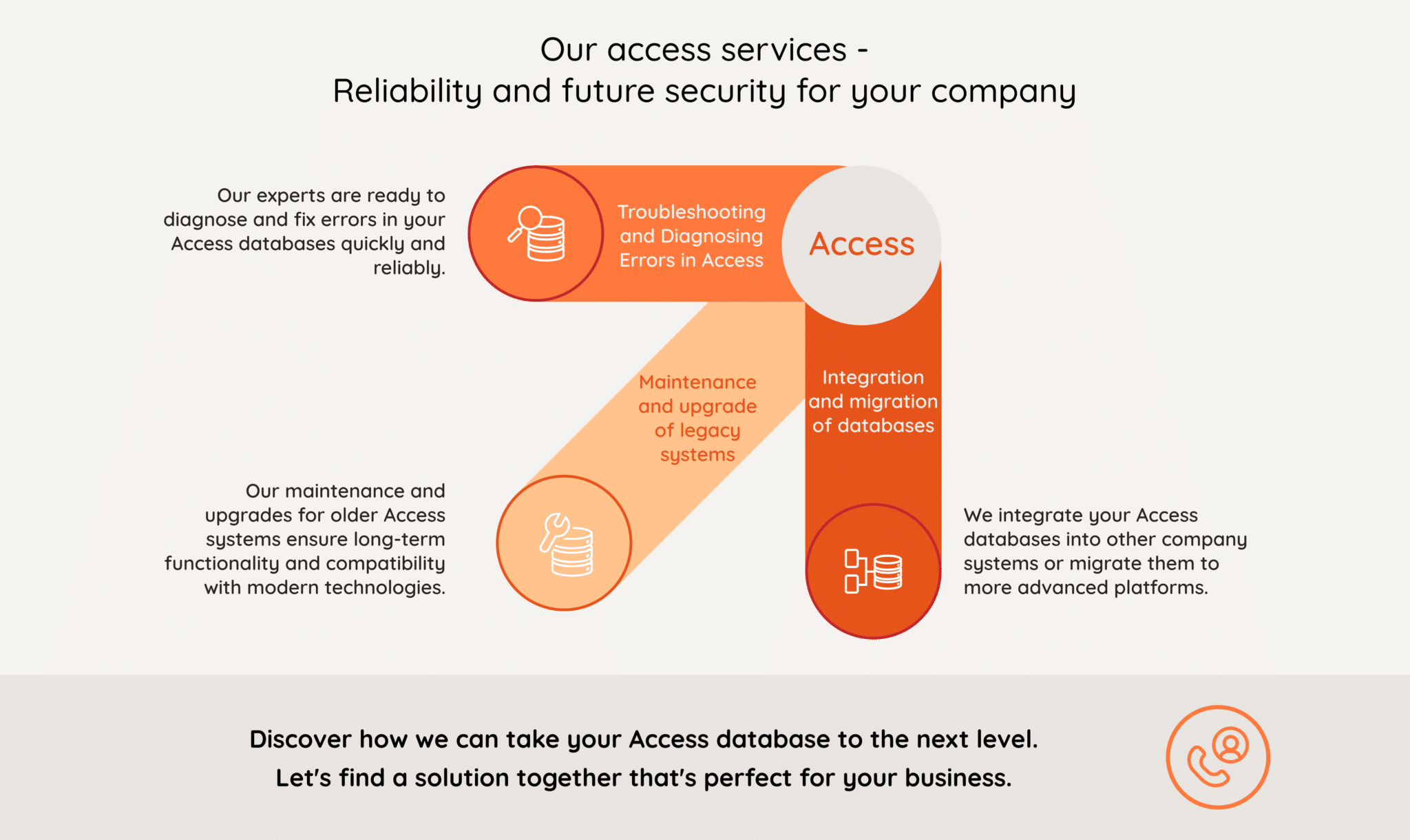

Access-Services von soxes, Englische Grafik

Common error messages after the 64-bit update

After switching to 64-bit Office, problems usually occur immediately, often as soon as the database is opened.

Frequent error messages:

  • “This database was created with the 32-bit version of Access”

  • “The code in this project must be updated for use on 64-bit systems”

  • Errors in the VBA code

  • Problems with ActiveX controls

  • Incompatible ODBC drivers or missing references

Tables can often still be opened, but forms, reports, or automated processes no longer work.

These messages indicate that parts of the database are technically tied to the 32-bit environment. If an Office update already leads to such failures, this is often a sign that the solution has reached its structural limits. Not only technically, but also strategically.

Why does this problem occur?

When switching from 32-bit to 64-bit Office, the technical environment changes in the background. While normal Office documents are hardly affected by this, large Access databases are sensitive to it.

Many Access solutions contain VBA code, interfaces to other systems, ODBC connections, or external components. These were often originally developed for a 32-bit environment.

With the 64-bit version, memory structures and dependencies change. Individual components of the database can then no longer be addressed correctly, leading to error messages or functional failures.

The update itself is therefore not the actual problem. It reveals that the existing solution is heavily dependent on outdated architecture.

Possible solutions

However, there are a few solutions that can help you solve the problem. We can assist your company with many processes so that you can continue to work efficiently.

1. Short-term solution: Back to 32-bit

A quick solution may be to uninstall the 64-bit version and then reinstall the 32-bit version of Office. This will allow you to access your database again immediately. However, this also means that you will lose the speed advantages of the 64-bit version. This is not a long-term solution for your company. You should consider alternatives so that you can use your data and your business does not come to a standstill.

2. Technical adaptation to 64-bit

In the long term, it is advisable to migrate your database to the 64-bit version. This requires a few steps:

  • Data backup: First, create a complete backup of your database.

  • Conversion: Use Access to open the database and convert it for the 64-bit version.
    (In many cases, this can be done using commands in the Access Developer tool.)
  • Update the VBA code: Check the VBA code in your database for 32-bit-specific declarations and adapt it to the 64-bit environment.
  • Test: Ensure that all functions of your database are working properly after the conversion.

Ask us if you need assistance with this.

3. Strategic modernization

If your Access database is business-critical, used by multiple employees, or integrated with other systems, a fundamental question arises:

Is it still worth repairing it technically? Or is now the right time for modernization?

A custom-developed solution offers:

  • Adaptability: it is tailored precisely to your requirements, resulting in more efficient processes.
  • Scalability: this solution can grow with your business and be easily expanded.
  • Integration: it can be seamlessly integrated with other systems used in your company.
  • Security: it often offers better security mechanisms because it is developed specifically for your environment.
  • Independence: You are not restricted by the limitations of third-party providers and can customize your software.

Unsure which option makes sense for your company?

We analyze your existing Access database and show you transparently:

  • Repair or migration?

  • Cost and risks

  • Modernization options

  • Economic evaluation

Arrange a non-binding consultation with us now.

Use of online services

Migrating your Access database to a cloud-based solution such as Microsoft Azure SQL Database or other relational cloud databases can also be an effective solution. This offers the following advantages:

  • Availability: Your data is accessible from anywhere and is no longer tied to a specific device.
  • Security: Cloud services often offer robust security features to protect your data.
  • Maintenance: Updates are handled by the cloud provider, saving time and resources.
  • Scalability: Cloud services can be easily scaled as needed.

Switching from a 32-bit to a 64-bit version of Office can cause problems when accessing Access databases, but with the right solutions, these challenges can be overcome. Whether by reinstalling the 32-bit version, migrating to the 64-bit environment, developing a custom software solution, or using cloud services. There is a suitable solution for every company.

Do you have similar problems or need assistance with database migration? Contact us today and together we will find a solution that helps your company! If you have any further questions or need professional support, we are happy to assist you.

This might interest you

Contact

Do you have any questions? Would you like to find out more about our services?
We look forward to your enquiry.

Sofia Steninger

Sofia Steninger
Solution Sales Manager