A production line comes to a standstill because an application has crashed. An order doesn’t make it into the ERP system. A machine control system that no one wants to touch anymore. In manufacturing, every software problem has a direct impact on production.
Custom Software for Industry and Manufacturing

What we offer industrial companies
-
Stabilize production-related software
We understand, document, and reliably maintain systems that are directly linked to machines and orders.
-
Modernize legacy systems
We gradually upgrade Delphi, Access, VBA, legacy .NET, PHP, FileMaker, and LabVIEW to the latest technology without disrupting operations.
-
Building bridges
ERP, MES, machines, databases, apps: No more manual reconciliation.
-
Digitize processes
From planning and production to quality control, maintenance, and reporting.
-
Preserve knowledge
Out of our heads and into clean architecture and documentation.
-
Ensure business continuity
One-stop service for implementation, maintenance, support, and further development.
When does production software become a risk?
Many industrial companies use software that has evolved over the years. It works, but it’s becoming harder to maintain, harder to expand, and harder to integrate with other systems:
- A core application is running, but no one dares to change it.
- The developer who knows the system is leaving soon. That knowledge goes with them.
- Production data is manually entered into Excel; the ERP system is unaware of it.
- The ERP, machines, and specialized systems do not communicate seamlessly with one another.
- Replacing it would be risky. But doing nothing is too.
Then you don’t need more talk about digitalization—you need a partner who thinks holistically about technology, processes, and operations.
Industry references
|
1.
Customer
|
2.
Industry / Context
|
3.
What did soxes do?
|
4.
Technology
|
|---|---|---|---|
|
Stadler Rail
|
Rail vehicle manufacturing, approximately 14,000 employees
|
A native app that digitizes and automates the quality control of rail vehicles. It integrates order and vehicle data, image uploads, and speech-to-text functionality, and automatically generates reports. In use worldwide since 2021, it reduces processing time per inspection by approximately 30%.
|
Native Android, interfaces to external systems
|
|
Electrolux
|
Home Appliances, Swiss Service Network
|
Replaces outdated Excel processes. Service technicians can enter daily reports on-site, create quotes, order confirmations, and warranty extensions, and place orders for replacement parts. Offline functionality with secure synchronization.
|
Laravel (Backend), Angular / TypeScript (Frontend), MariaDB
|
|
Mecos AG
|
Active magnetic bearing technology for turbomachinery
|
I couldn't find the project details on the live site. Please add them from your internal source, and I'll finish filling in that line.
|
Power BI
|
|
TESTEX
|
Testing and certification company (OEKO-TEX)
|
Transforms the OEKO-TEX certification process, which was previously based on manuals exceeding 70 pages, into a standalone application. TMA digitizes complex calculations, processes orders via automated workflows, and replaces the manual certification matrix. The result: shorter training times, fewer errors, and noticeably higher quality in the certification process.
|
Microservices, Azure Logic App, robust backend
|
|
REFCO Manufacturing
|
Refrigeration and HVAC Technology, Tool Manufacturer (50+ years)
|
App for field technicians: connects to REFCO devices via Bluetooth, reads measurement data in real time, generates customer reports, and sends reports directly as PDFs. It also manages devices, firmware updates, and refrigerant lists.
|
React Native (iOS and Android), Python backend via API
|
|
EFCO
|
Fastening technology, manufacturer with an online store
|
Migrated the existing Magento store to Magento 2 and added new features. soxes created the complete specifications, developed a new design concept in line with EFCO’s corporate identity, and built the store, which features several thousand linked products for builders.
|
Magento 2
|
|
Sulzer AG
|
Pump manufacturer, Winterthur (approximately 15,000 employees, 20+ production sites)
|
Consolidates the entire project process at Sulzer Pumps into a single application built on Microsoft Access and Excel. Lists orders with filters by order number, customer, project, and project manager, sorted by delivery dates. Includes an Excel interface to the ERP system, supports reports up to DIN A0 size, is multi-user capable, and is in use worldwide.
|
Microsoft Access, Excel, ERP interface
|
More and more industries are turning to custom software
While off-the-shelf software in Switzerland is typically developed for use across multiple industries and primarily covers general functions such as accounting or inventory management, custom software is specifically designed to meet theunique requirements of individual industries or companies.
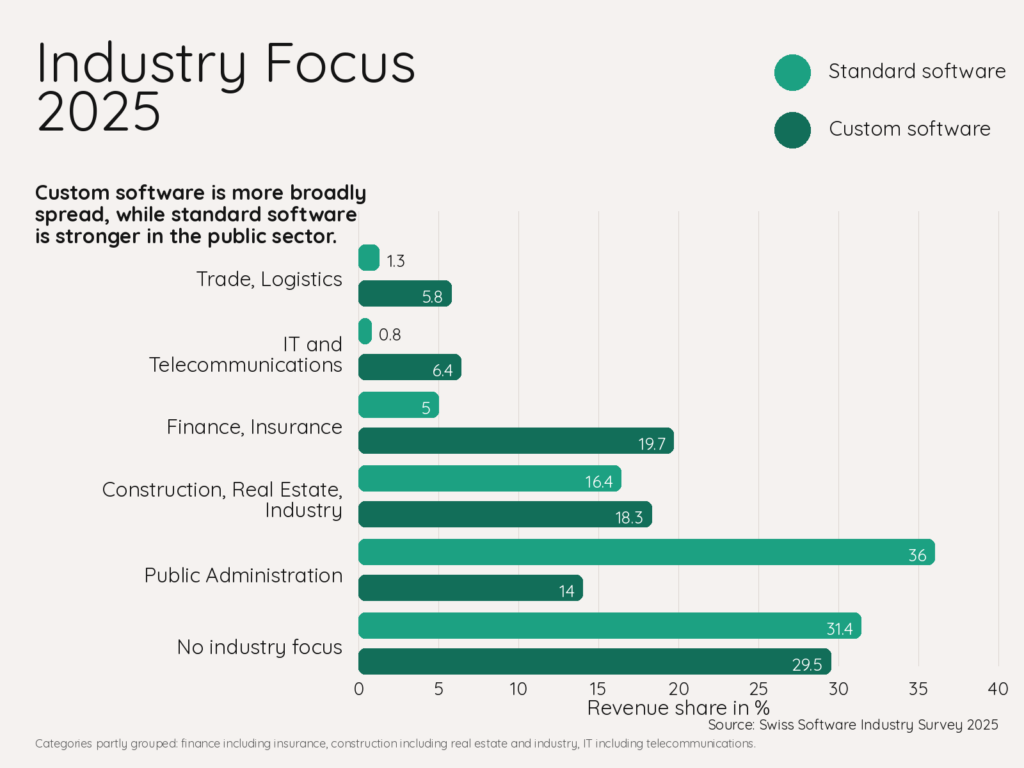
Source: SSIS 2025, pp. 15–16
Typical industrial applications
-
Production Management
Manufacturing planning and control systems are often built using older technologies that are not compatible with modern analytics tools or real-time dashboards.
-
Maintenance and Repair Systems
Software that monitors machines and schedules maintenance cycles. Safety-critical applications where errors cannot be tolerated.
-
Logistics and Warehouse Management
Software used to coordinate material flows and manage inventory is often a standalone solution that is not integrated with modern ERP systems.
-
Quality Control and Documentation
Software for collecting and analyzing production data is often directly linked to machines and requires customization.
Our Approach
Software issues in industry grow quietly. One more Excel spreadsheet, an interface with a workaround, a developer who’s about to leave. Eventually, operations are at risk.
An initial consultation assesses the situation: What is still manageable, where are the biggest risks, and what can provide quick relief. Clarity before things get critical. Learn more about how we work together here!
Here’s how we get started
- Understand: We listen and examine processes, systems, and dependencies.
- Assess: Where are the risks, manual efforts, and modernization needs?
- Prioritize: We decide together what needs to be stabilized, improved, or renewed first.
- Implement: We develop, integrate, and modernize step by step, working closely with your operations.
- Ongoing Support: Upon request, we handle maintenance, support, and further development.
Frequently asked questions
-
How much does it cost to modernize industrial software?
-
How long does a software upgrade take in manufacturing?
-
Modernize or build from scratch, which makes more sense?
-
How can production software be updated without halting manufacturing operations?
-
What is an MES, and when does a manufacturing company need one?
-
How secure is corporate data during a modernization project?
Before the problem turns into an emergency!
In a no-obligation initial consultation, we’ll assess your situation together.
Tell us about your production and your systems. After 30 minutes, you’ll know what the risks are and where we can help you!
Trusted by Leading Brands